Rechercher dans ce blog

Friday, October 30, 2020

These States Could Flip From Red To Blue During The 2020 Election - NPR

red.indah.link

There are four days left to vote before Election day, and a number of states are still a toss-up. Georgia, Texas and Arizona have historically voted Republican but could swing the other way this year.

DAVID GREENE, HOST:

As this election season enters its final days, the presidential candidates have been in predictable places - swing states like Florida, where President Trump and Joe Biden spent time yesterday. Both will be in Wisconsin today, but their running mates head today to less predictable places. Vice President Mike Pence will be in Arizona. Arizona Senator Kamala Harris goes to Texas. Now, what that tells us is there are some reliably red states that the campaigns are seeing as competitive. I mentioned Arizona and Texas. Georgia is another one. And we have reporters in all three states this morning.

And I want to begin with Emma Hurt of WABE. She joins us from Atlanta. Emma, good morning.

EMMA HURT, BYLINE: Good morning.

GREENE: So Georgia's seen a lot of action from candidates in recent days. It must feels - feel like there's a really important election happening there.

HURT: Yeah, something like that. It's been really head-spinning. So on the Democratic side, Joe Biden came on Tuesday. And he was the first Democratic presidential candidate to come to Georgia this close to an election in more than 20 years. Jill Biden was here on Monday - her second trip. Kamala Harris was here last week.

And President Trump on the Republican side is expected to come on Sunday. And he's already been here three times since the summer, as have - his children have visited and Vice President Pence as well. And this is all a big deal because in 2016, no presidential candidates came to Georgia after the primary, and Trump won by 5 points.

GREENE: So what is different? Why are they treating Georgia differently this time?

HURT: Yeah. There are a couple of layers to this, particularly if you look at Biden's decision to visit. First up, we've got all this polling showing that Georgia is a toss-up. And historically, margins have been narrowing here. In 2018, the governor's race was settled by just 55,000 votes. But also, the early voter turnout we're seeing has been - seems to have been a factor. Like around the country, we're seeing record-breaking numbers, but within that turnout, some numbers in particular look good for Democrats, like a big increase in young voters, for example. And it's also not just the presidential race that's close in Georgia this year. There are two Senate races. And Biden called that out directly this week.

(SOUNDBITE OF ARCHIVED RECORDING)

JOE BIDEN: I can't tell you how important it is that we flip the United States Senate. There's no state more consequential than Georgia in that fight.

HURT: You know, one of those Senate races, a special election, is pretty likely to end up in a runoff, and the other very well might end up in one as well. And these factors are energizing Democrats but also energizing Republicans who are fighting to keep control of Georgia.

GREENE: Talk about why these margins are closing. I mean, are people changing their minds politically?

HURT: Georgia is changing. You know, demographically, it has been for a while. The Atlanta metro area in particular has grown a lot and is expected to keep doing so. We've had a lot of in-migration from other states. And a lot of this growth has been in communities of color. Atlanta's majority minority, and Georgia is getting there. And then all these new people are being registered at unprecedented levels. There are about a million new registered voters this year compared to 2016.

GREENE: All right. Emma, I want to turn from Georgia to Texas. Ashley Lopez from KUT is in Austin. Hi, Ashley.

ASHLEY LOPEZ, BYLINE: Hey.

GREENE: So is this the case in your state, too? Is the race closer there partly because, as Emma said, more people are voting and the parties are saying that this could be closer than they think?

LOPEZ: Well, yeah. That's definitely a big part of what's happening. I mean, Texas has historically had some of the lowest voter turnout in the country, but we've been leading the nation during almost all of early voting at this point. More than 8 million people have already voted here. I mean, I should note that this is largely in-person early voting because state officials extended early voting to three weeks this year. It's usually two. And just like in Georgia, notably, a lot of young people have been voting here. Texas is a pretty young state. So this is, like, a big catch for Democrats and definitely a big change in the electorate because, obviously, like, young voters historically also don't vote in high numbers.

And then, of course, there's that, like, suburban political change that's been happening throughout the country. In Texas, that's particularly true. Like, many of the counties, particularly around here in Austin - some of the suburban counties near us have been seeing, like, record turnout. They've already blown through their 2016 voting totals, and that includes Election Day 2016. And that - like, some of them blew through it last weekend. So turnout has actually been pretty staggering here.

GREENE: But reality check - Texas has not shown up for a Democratic candidate since Jimmy Carter 1976. It's been a while. I mean, how much have demographics changed in this state?

LOPEZ: Well, first, it's just grown a lot. The state has gotten a lot bigger since 1976, something like 130% bigger population-wise. And as that population has grown, it's also gotten more racially diverse. Latinos make up a huge chunk of that growth in those past few years - several decades, I guess I should say - and not just in big cities, but lately, like, those suburban counties that I was talking about have also gotten more racially diverse.

And, you know, like in Georgia, you know, this wasn't mentioned, but in 2018, there was a very exciting race in both those states. So here in Texas, we had a U.S. Senate race that was really exciting and brought a new - a bunch of new voters into the fold. And, you know, Democrats, even though they didn't win that U.S. Senate race, you know, because they got so close, it seemed to have electrified Democratic voters in a big way. And I don't think that seems to have gone away. But, I mean, of course, we'll know for sure soon whether that enthusiasm has, like, kind of stuck around.

GREENE: When the votes are actually counted - that's the important moment.

LOPEZ: Right, yeah.

GREENE: Well, let's go to Arizona. I want to bring in Jimmy Jenkins from member station KJZZ in Phoenix. Jimmy, apart from Bill Clinton's win in '96, Arizona hasn't voted for a Democrat since 1948. I mean, does Joe Biden really have a chance there?

JIMMY JENKINS, BYLINE: Seems possible, David. Like in Georgia and Texas, Arizona's population has been growing. People are moving here from places like California with a higher cost of living. They're moving here from lots of different places in the Midwest, and they're bringing their values with them. More voters are turning out this year in Arizona. We now have close to 4.3 million registered voters. That's up nearly 700,000 from this time in 2016. Early vote totals have exceeded 2016 numbers statewide.

We also expect a huge turnout from the Latino community, potentially hundreds of thousands more voting this year than in 2016. Latinos make up roughly 30% of Arizona residents. And there's been a lot of activism over the past decade and an aggressive voter registration campaign by Latino organizers. And many of them tell me, when it comes to the presidential election, Latino voters may be lacking some enthusiasm for Biden, but they are simply fed up with the years of oppression and demonization that they see coming from President Trump.

GREENE: More Latino voters turning up at the polls, more people living in Arizona in general - I mean, would you say this has changed the issues that voters care about in general?

JENKINS: Yes. There has been a big change since 2016. And even in just the past year, Arizona voters' priorities have shifted dramatically from immigration to education as the No. 1 priority. So with that shift, more Arizonans appear to align with Joe Biden's platform than with President Trump.

GREENE: Jimmy Jenkins from KJZZ in Phoenix. KUT's Ashley Lopez in Austin, Texas. WABE's Emma Hurt in Atlanta. Thank you all.

HURT: Thank you.

LOPEZ: Thanks.

JENKINS: You're welcome.

Copyright © 2020 NPR. All rights reserved. Visit our website terms of use and permissions pages at www.npr.org for further information.

NPR transcripts are created on a rush deadline by Verb8tm, Inc., an NPR contractor, and produced using a proprietary transcription process developed with NPR. This text may not be in its final form and may be updated or revised in the future. Accuracy and availability may vary. The authoritative record of NPR’s programming is the audio record.

The Link Lonk


October 30, 2020 at 05:56PM
https://www.npr.org/2020/10/30/929402220/these-states-could-flip-from-red-to-blue-during-the-2020-election

These States Could Flip From Red To Blue During The 2020 Election - NPR

https://news.google.com/search?q=Red&hl=en-US&gl=US&ceid=US:en

Roglic back in red after third Vuelta stage win - Yahoo Sports

red.indah.link
FILE PHOTO: Tour de France

SUANCES, Spain (Reuters) - Primoz Roglic produced a brilliant finish to claim an unlikely victory on stage 10 at the Vuelta a Espana on Friday and move back into the race leader's jersey.

The 185km flat route from Castro Urdiales to Suances had been earmarked as one for the sprinters. However, the Slovenian showed fantastic timing to launch away from the main group inside the final 100 metres of the uphill finish in Cantabria on Spain's northern coast.

“I’m super happy. It’s never easy but I had the legs and this is really, really nice," he said.

"I’m one year older (after turning 31 on Thursday) but I’m stronger - like wine, the older the better.

"I’m back in red but that doesn't really change things for my team. We need to keep the momentum going. We have a weekend in the mountains. It will be fun to watch and we’ll do our best.”

Ireland's Sam Bennett, one of the pre-stage favourites who was relegated to the final position in the bunch for barging into another rider in the closing stages of yesterday's ride having initially won the sprint, was dropped with 27km to go. [nL1N2HK2N2]

From then on the teams fought to protect their general classification contenders and it was a strategy that worked perfectly for Roglic and his Jumbo-Visma team mates.

Roglic's strong finish meant he pulled away from a group containing red jersey wearer Richard Carapaz, whom he started the day 13 seconds behind.

There was some confusion at the line as Ecuador's Carapaz was initially awarded the same finish time as the 2019 Vuelta winner before race judges later deemed he had actually finished in the following group, three seconds down.

Roglic's 10-second stage win bonus moved him back into the race lead, level on time with the Ineos rider but ahead thanks to his three stage victories so far.

The race returns to the mountains on Saturday, with a punishing 170km stage that takes in five categorised climbs - four of which are first category - from Villaviciosa, finishing at the summit of the Alto de la Farrapona.

(Reporting by Joseph Cassinelli; Editing by Christian Radnedge and Ken Ferris)

The Link Lonk


October 31, 2020 at 12:25AM
https://sports.yahoo.com/roglic-back-red-third-vuelta-172533683.html

Roglic back in red after third Vuelta stage win - Yahoo Sports

https://news.google.com/search?q=Red&hl=en-US&gl=US&ceid=US:en

Why Blue Places Have Been Hit Harder Economically Than Red Ones - The New York Times

red.indah.link

The coronavirus recession has been more severe in Democratic-leaning places than in Republican-leaning ones. Blue states like Massachusetts and California have had steeper job losses, higher unemployment and bigger drops in job postings than red states like Utah and Missouri.

It turns out that most of this partisan gap in economic suffering is because of the different mix of jobs in red and blue places.

The partisan jobs gap has been fairly consistent throughout the pandemic. Employment in blue states fell more in the first two months, and the cumulative employment decline has remained significantly worse in blue states than in red states since June.

The partisan gap in jobs hasn’t gone away because it’s rooted in fundamental economic differences related to job types. The worst job losses have been in the leisure and hospitality sector, and in travel and recreation destinations like Honolulu, Las Vegas and New Orleans.

The sectors with the biggest job losses in the pandemic tend to be located in bluer counties. Across all industries, 57 percent of employed people live in counties that Hillary Clinton won in 2016. Among hard-hit sectors in the pandemic, 59 percent of workers in lodging and food service; 63 percent in arts, entertainment and recreation; and 66 percent in information industries like publishing, film and telecommunications live in counties that Mrs. Clinton won. In contrast, jobs in most sectors less harmed by the pandemic, like utilities, construction and manufacturing, are disproportionately located in counties that President Trump won in 2016.

Furthermore, local economies are struggling in places where more people can work from home. Although job losses have been milder in sectors (such as tech, finance and professional services) where many people can work from home, local businesses like retail and restaurants have been slower to hire in places where more people can work from home. That helps explain why job losses have been steep in tech hubs and finance centers like New York and San Francisco. Looking across all metros, employment has fallen more since February in metros where more people can work from home. And work-from-home metros tend to lean strongly blue.

The correlation between a metropolitan area’s employment change between February and September and the metropolitan area’s 2016 presidential vote margin for Trump is 0.53 (where 1 represents a perfect relationship and 0 represents no relationship).

In other words, redder places had milder job losses, and the relationship is strong. But when adjusted for the local occupational and industry mix, that correlation drops to 0.22.

Other factors that are correlated with partisanship are also systematically related to job losses during the pandemic. Employment has fallen more in larger metros and those metros with a higher cost of living — perhaps as people move away from cities, possibly to more affordable places, or as businesses struggle where rents and local wages are higher. Add in metropolitan population and cost of living alongside job mix to the analysis, and the correlation between employment change and vote margin falls further to 0.17.

So that means more than two-thirds of the partisan gap can be explained by local job mix, size of the population, and cost of living. These factors explain most of the partisan gap in other economic measures, too, like the rise in unemployment and the drop in job postings on Indeed.

The relatively small partisan gap in economic outcomes that remains could be a result of differences in restrictions or in individual behaviors. Throughout the pandemic, there have been clear partisan differences in concern about outbreaks, mask wearing and social distancing. Research suggests that individual choices contributed more than lockdown policies to declines in economic activity, and places that imposed few restrictions still lost jobs.

The coronavirus recession is unusual in that services employment (like at restaurants) has declined more than goods-sector employment (like at factories). All other recent recessions have hit goods-related industries worse, which tend to be more concentrated in Republican-leaning places.

Longer-term government projections point to a far different picture. Faster employment growth is expected in sectors that are concentrated in bluer areas. But the higher cost of living in blue areas might be a drag on growth if, post-pandemic, more people continue to work remotely and some move to more affordable regions. Still, the future looks far more promising than the present for blue states’ economies.


Jed Kolko is the chief economist at Indeed.com. You can follow him on Twitter at @JedKolko.

The Link Lonk


October 30, 2020 at 04:00PM
https://www.nytimes.com/2020/10/30/upshot/red-blue-economic-recovery.html

Why Blue Places Have Been Hit Harder Economically Than Red Ones - The New York Times

https://news.google.com/search?q=Red&hl=en-US&gl=US&ceid=US:en

How to spot a red or blue 'mirage' in early election night results - CNN

red.indah.link
[unable to retrieve full-text content]How to spot a red or blue 'mirage' in early election night results  CNN The Link Lonk


October 30, 2020 at 06:39PM
https://www.cnn.com/2020/10/30/politics/red-blue-mirage-election-results/index.html

How to spot a red or blue 'mirage' in early election night results - CNN

https://news.google.com/search?q=Red&hl=en-US&gl=US&ceid=US:en

Hadley council: Turns on red at central intersection will help keep cars off local roads - GazetteNET

red.indah.link

Staff Writer

Published: 10/29/2020 8:54:45 PM

HADLEY — A request from Hadley officials to the state Department of Transportation to make changes to the main intersection in town center is part of a continued effort to have vehicles traveling through town use the state roads, rather than going through residential neighborhoods.

The Select Board Wednesday voted 4-1 to ask the state to remove the “no turn on red” signs at the corner of Routes 9 and 47.

The idea behind taking down the signs is to encourage more drivers, especially those traveling from Amherst to Northampton, to remain on Middle and Russell streets, roads maintained by the state, rather than using North Lane and West Street to get to Route 9.

Only board member Jane Nevinsmith voted against the contents of the letter, noting she is worried that pedestrians who need to cross Route 9 will be at risk of being clipped by turning vehicles. Senior citizens were among those who asked for the installation of the signs to promote safety.

But board member John C. Waskiewicz II said it is already illegal for vehicles to make a turn when the crosswalk light is activated and pedestrians are in the crosswalk.

After extensive discussion, though, the board narrowly rejected, by a 3-2 vote, a second letter that would have asked the state to install signs prohibiting eastbound vehicles on Route 9 from making left turns onto West Street, Whalley Street and Goffe Street.

The decision came after the board asked the Department of Public Works earlier in the month to install speed tables on North Lane to see if that would reduce traffic on West Street passing by the historic town common.

Board member Christian Stanley said no letter should be written without input from West Street families, observing that prohibiting the turn would force residents to change their routes home.

In addition, there was uncertainty about whether drivers would be confused about making left turns to access buildings on the north side of Route 9, such as Most Holy Redeemer Catholic Church and the Dunkin’ Donuts.

Nevinsmith said the ban could also throw a wrench in activities held on the common.

Chunglo, though, said she believes West Street residents want the change. “I think they’ll be more happier without excess traffic going 50 mph down their street,” Chunglo said.

She was joined in support by Chairman David J. Fill II. He argued that cutting down on traffic and reducing chances of rear-end crashes on Route 9 is a good reason to prohibit left turns for eastbound vehicles.


The Link Lonk


October 30, 2020 at 07:58AM
https://www.gazettenet.com/Changes-sought-for-main-intersection-in-Hadley-center-37044475

Hadley council: Turns on red at central intersection will help keep cars off local roads - GazetteNET

https://news.google.com/search?q=Red&hl=en-US&gl=US&ceid=US:en

Thursday, October 29, 2020

Open Doors plans to operate low barrier shelter out of former Red Front Supermarket - WHSV

red.indah.link

The Augusta County Commonwealth’s Attorney’s Office has received $600,000 from the Department of Justice. The money will go toward efforts to identify, treat and support those affected by the illicit use of opioids and other drugs through the office’s Law Enforcement Assisted Diversion Program (LEAD). “We don’t really have as big of an opioid problem here, in Augusta County we do have a meth problem,” Caleb Kramer, Assistant Commonwealth’s Attorney, said. The grant will fund a new case management program, which will connect higher risk offenders with community resources prior to them being charged. It will first be used to hire a full-time project manager, who will be in charge of integrating with local organizations and coordinate services that are needed. Some examples may include, collaboration for services with shelters, career services groups, counselors, drug treatment centers, and vocational services. “I wanted to be able to bring a full force of all the community resources that I can to help these people out and help drive them toward a more positive direction in their lives,” Kramer said. He added, “Case managers will be instrumental in ensuring immediate intervention, right after arrest for example, as well as continuity of care which, evidence shows, are critical to offenders' long-term success.” The Commonwealth’s Attorney’s Office reported success with its current LEAD program, the Pre-charge Diversion and Litter Control Program, which diverts first-time, low-level offenders to community service and requires them to remain charge free and drug-free and to participate in interventions. The Augusta County Litter Control Program reports more than 36,000 pounds of trash collected in 2019. That’s over 24,000 pounds more than in 2018. The program also recorded a significant increase in man-hours and miles covered in 2019. Those numbers will drop a bit for 2020, due to COVID-19 pausing the program. Kramer said you can help to continue lowering those numbers by not littering, which is one thing this program teaches. “It’s very culture changing. I’ll have participants who, when they start, maybe joking about there being litter. Like, ha ha. I probably did some of this. At the end of it, they’ll be like, if my friends ever do that again, I’m going to yell at them,” Kramer said. The Augusta County Litter Control program reports they picked up 410 tires along roadways in 2019, which is up from 71 in 2018. Kramer said it’s mostly from people illegally dumping tires in embankments. He said improper disposal of tires can not only take away from the county’s beauty, but it can also be harmful to the environment. “Contributes to a lot of disease and pests that we don’t like that are disease vectors. I think there’s a huge amount of effects. They’re not visible, but just because they’re not visible doesn’t mean they’re not there,” Kramer said. You can properly dispose of tires at the Augusta County landfill and you can report trash you see along the roadway to the program by calling 540-254-7826.

The Link Lonk


October 29, 2020 at 06:53AM
https://www.whsv.com/2020/10/28/open-doors-plans-to-operate-low-barrier-shelter-out-of-former-red-front-supermarket/

Open Doors plans to operate low barrier shelter out of former Red Front Supermarket - WHSV

https://news.google.com/search?q=Red&hl=en-US&gl=US&ceid=US:en

COVID Risk Map: Over 1/3 of Mass. Communities in Red, New Data on Clusters - NBC10 Boston

red.indah.link

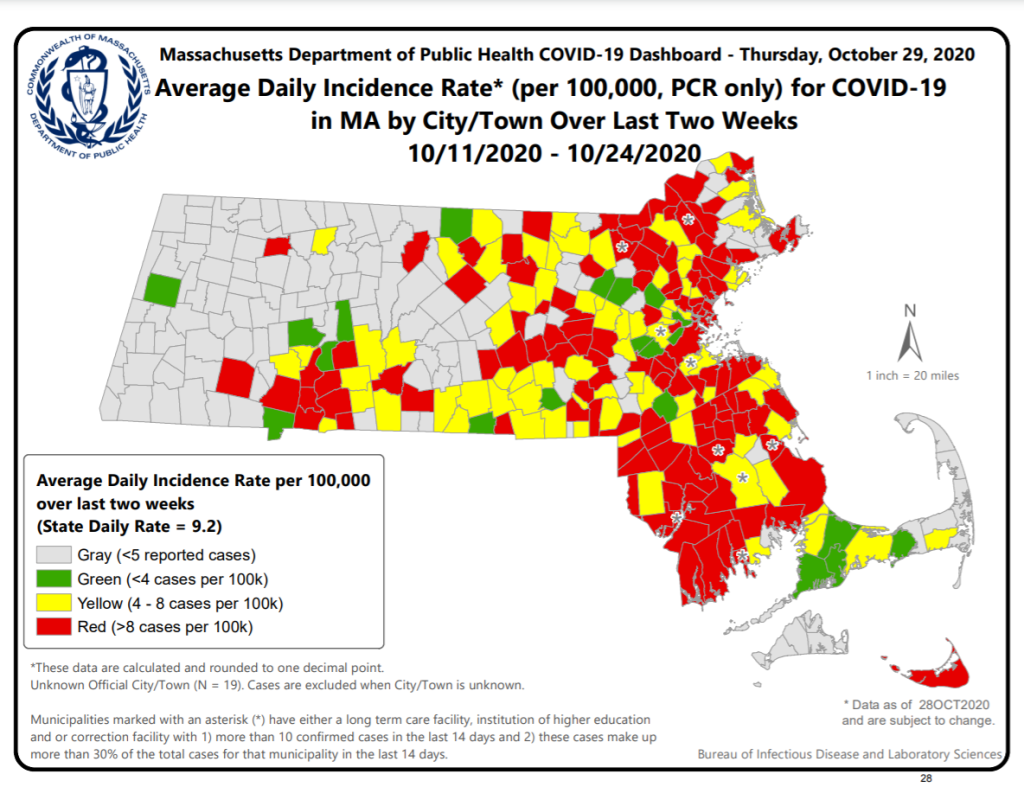
Massachusetts' latest weekly community-level data on the coronavirus pandemic, including the updated town-by-town COVID-19 risk assessment map, shows vast swaths of red as 121 communities are now considered at the highest risk for transmitting the virus, an increase of 44 from last week.

That means more than one-third of the state's 351 communities are in the map's red zone. Fifty-four communities joined the list this week while 10 moved out of it. And 15 communities that have consistently been in red will have to move back to Phase 3, Step 1 of the Massachusetts reopening plan.

This week's report from the Department of Public Health includes new data on COVID-19 clusters and the origins of new cases, showing nearly 3,000 new clusters have been identified since late September. Last week's report had been revamped to include data on isolated outbreaks, requiring its release to be moved back from Wednesdays to Thursdays.

The data, from the Department of Public Health, includes a breakdown of the total number of coronavirus cases in each Massachusetts city and town, as well as the new map and more data. See it here.

See the Town-by-Town Mass. Coronavirus Risk Map

The following communities are in the highest risk level as of Thursday: Abington, Acushnet, Agawam, Ashland, Athol, Attleboro, Avon, Bedford, Bellingham, Berkley, Beverly, Billerica, Blandford, Bolton, Boston , Boxford , Braintree, Bridgewater*, Brimfield, Brockton, Buckland, Canton , Chelmsford*, Chelsea , Chicopee, Clinton , Cohasset, Danvers, Dartmouth, Dedham , Dighton, Dover, Dracut, East Brdgewater, East Longmeadow, Everett, Fairhaven*, Fall River, Fitchburg, Foxborough, Framingham, Freetown, Gardner, Georgetown, Gloucester, Granby, Hanover, Hanson, Haverhill, Hingham, Holliston, Holyoke, Hubbardston, Hudson, Kingston*, Lakeville, Lawrence, Leicester, Leominster, Littleton, Lowell, Lynn, Lynnfield, Malden, Mansfield, Marlborough, Marshfield, Medford, Mendon, Methuen, Middleton, Milford, Nahant, Nantucket, New Bedford, Newburyport, North Andover*, North Attleborough, Northborough, Norton, Norwood, Palmer, Peabody, Pembroke, Plymouth, Randolph, Raynham, Revere, Rochester, Rockland, Salisbury, Saugus, Seekonk, Shrewsbury, Somerset*, Southborough, Springfield, Swansea, Taunton, Tewksbury, Townsend, Tyngsborough, Wakefield, Waltham, Wareham, Webster, West Boylston, West Bridgewater, West Springfield, Westborough, Westfield, Westport, Westwood, Weymouth, Whitman, Wilmington, Winchester, Winthrop, Woburn, Worcester and Wrentham

The asterisks indicate that a local institution accounts for at least 11 cases in the community and those cases make up 30% or more of the community's total cases over the last two weeks.

Because they've been on the list for three consecutive weeks, the following communities must move to Step 1 of Phase 3 of Massachusetts' reopening plan starting Monday: Abington, Berkley, Canton, East Longmeadow, Fairhaven, Fall River, Hanover, Hanson, Hingham, Marshfield, Milford, Pembroke, Rockland, Wakefield, and Weymouth.

Mass. COVID hot spot map
Mass. Dept. of Public Health

This map shows the average daily number of coronavirus cases per capita in Massachusetts from Oct. 11-24, 2020. Asterisks indicate communities where an outbreak at an institution accounts for a significant portion of cases.

The map shows the number of cases detected on average each day over the last two weeks in each of Massachusetts' communities. More than 8 cases per 100,000 translates to a high risk and red shading, between 4 and 8 cases per 100,000 is moderate risk and any less than that is low risk.

There are 121 cities and towns shaded red in this map, an increase of 57% from last week's map. There were 77 communities on that map, which included data from Oct. 4-17, an increase of 14 communities from the week prior.

These 54 communities are new to the list since last week: Agawam, Athol, Bedford, Bellingham, Beverly, Billerica, Blandford, Bolton, Braintree,Bridgewater*, Brimfield, Cohasset , Danvers, Dartmouth, Dedham, Dighton, Dover, Dracut, East Bridgewater, Fitchburg, Foxborough, Freetown, Gardner, Georgetown, Granby, Hubbardston, Lakeville, Leominster, Littleton, Mansfield, Medford, Mendon, Nahant, Nantucket, Newburyport, North Attleborough, Northborough, Norton, Palmer, Peabody, Salisbury, Southborough, Swansea, Taunton, Tewksbury, Townsend, Wareham, West Boylston, West Springfield, Westborough, Westwood, Whitman, Wilmington and Winchester

And Amherst, Auburn, Dartmouth, East Bridgewater, Holbrook, Littleton, Nantucket, Southborough and Sunderland have left the highest risk level since last week.

Read this week's full report here, with data on communities' percent positivity, county- and state-level data and more.

New Data on Mass. COVID Clusters

This week, Gov. Charlie Baker said the latest report would include "more data around COVID clusters and where the new cases are coming from."

That data shows that 2,945 coronavirus clusters have been detected between Sept. 27 and Oct. 24. The vast majority have been associated with households and they've led to 8,208 confirmed cases.

The state defines clusters are at least two COVID-19 cases associated with one location, and it considers the information useful for learning where people are being infected.

Since Sept. 27, all but 238 of identified clusters were associated with households. Long-term care facilities have the next most clusters, 59.

Changes to Massachusetts' Hot Spot Map

Massachusetts has now changed how it's measured coronavirus metrics over time, and this month brought two significant revamp that may address some small communities' concerns.

Before this week's report added cluster information, last week's was the first to include coronavirus clusters in institutions like jails, colleges and nursing homes. Such outbreaks have pushed communities into that red zone before.

"Adding this identification acknowledges the impact of a particular institution or facility on the community’s case count and provides valuable information for residents and municipal leaders to consider when implementing policies in their community," the state's COVID-19 Response Command Center said in a statement at the time.

Having an asterisk won't change whether a city or and town can move forward or backward in Massachusetts' reopening plan or if more people can gather together, according to the command center. The asterisk doesn't change the red or yellow status.

The color-coded town-by-town data was introduced in August, and the Baker administration announced that the state would focus its strongest COVID-mitigation efforts on towns in the red category. Communities can only move to Step 2 of Phase 3 of Massachusetts' reopening plan, announced in late September, if they are not consistently in the red.

Before the map's introduction, the positive COVID test rate over the preceding 14 days had been the standard for measuring hot spots. The Department of Public Health's weekly report still includes that information, along with other metrics like how many tests are being conducted locally and how many cases have been reported locally.

However, some of Massachusetts' smaller towns have taken issue with being categorized based on cases per capita.

They have said that, when a town only has a few thousand people, an outbreak in just one household can send it into red, which is determined by 8 cases of COVID-19 per 100,000 residents.

Asked earlier why he prefers using cases per capita instead of percent positivity, Baker said the latter doesn't take into account that some people get tested repeatedly.

"We have a lot of repeat testers in our data, many of whom are repeating for work-related reasons," Baker said.

The Link Lonk


October 30, 2020 at 08:28AM
https://www.nbcboston.com/news/coronavirus/covid-risk-map-more-than-1-3-of-mass-communities-in-red-new-data-on-clusters/2220442/

COVID Risk Map: Over 1/3 of Mass. Communities in Red, New Data on Clusters - NBC10 Boston

https://news.google.com/search?q=Red&hl=en-US&gl=US&ceid=US:en
Featured Post

Know Your Opponent | New York Red Bulls - Orlando City SC

red.indah.link Orlando City (6-1-3, 21 pts), winner of three in a row and five of its last six, will look to keep its place near the top o...

Popular Posts